
American Sign Language & Interpreter Training

American Sign Language & Interpreter Training
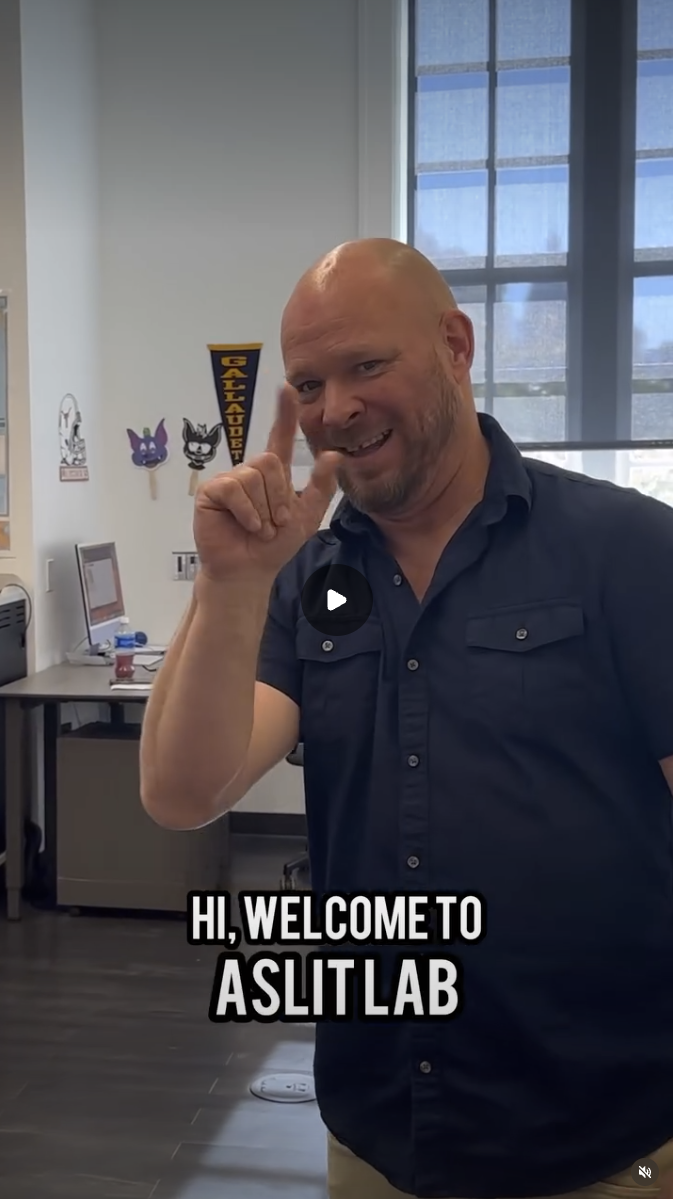
Welcome to ASLIT Lab
Welcome to the ASLIT Lab! We’re glad you’re here! Our mission is to provide a professional, supportive, student-centered environment. The purpose of the ASLIT Lab is to practice expressive and receptive skills, improve your ASL grammar skills, and build confidence in your signing skills. Our tutors are selected for their native ASL fluency, deep Deaf cultural knowledge, credentials, and ability to relate to a diverse student population — all in service of a stimulating, creative, and cooperative community. We look forward to supporting your success in ASL!
Read the instructions and FAQs below before requesting a reservation.
Hours
ASLIT Lab is currently offering tutoring sessions both in-person and virtually.
Fall 2026
In-person & Virtual Hours:
Monday-Thursday 8am-8pm
Friday 8am-Noon
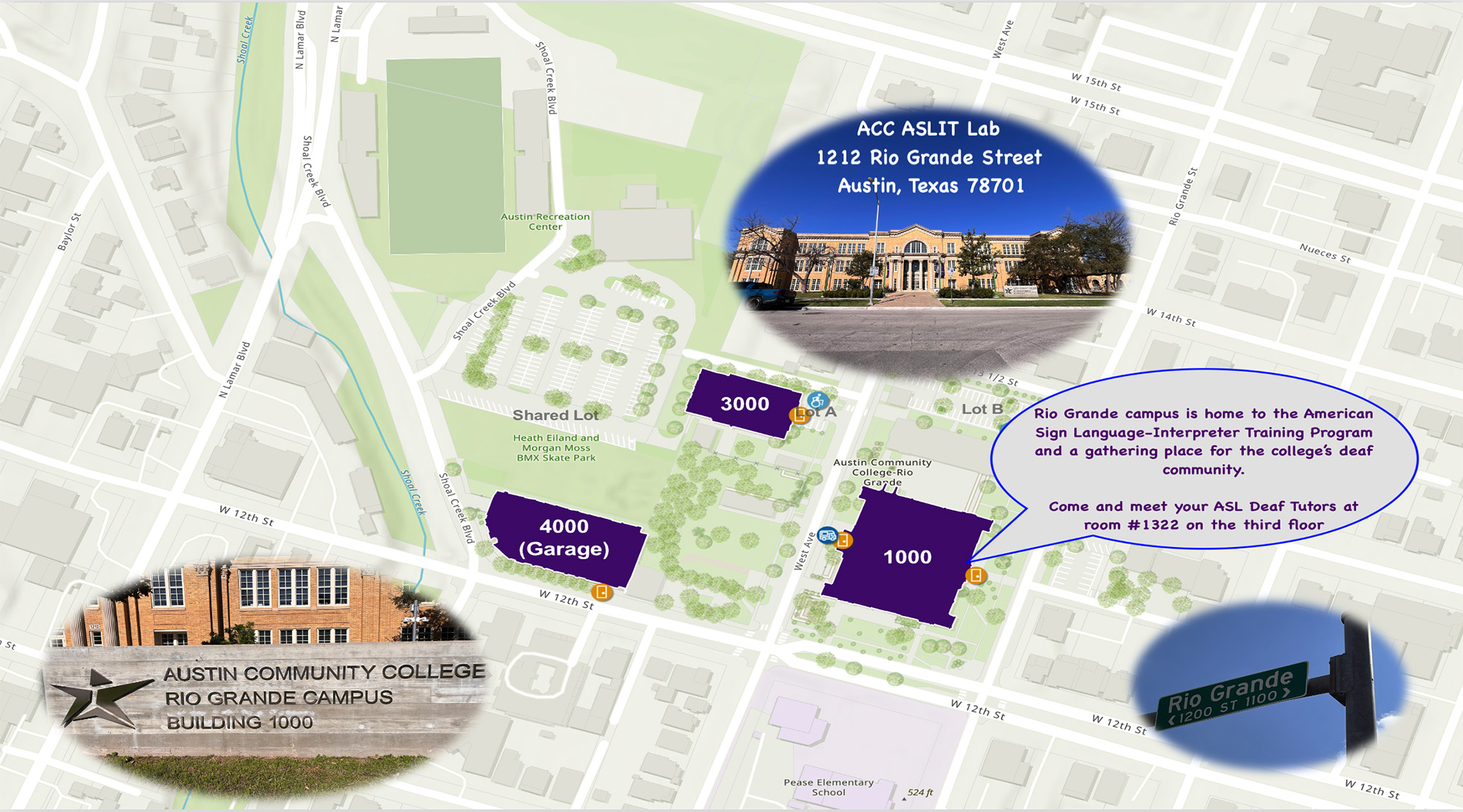
Location
ASLIT Lab:
1212 Rio Grande Street, Austin, Texas 78701
Building 1000, 3rd Floor, Room #1322
Email: [email protected]
Click on the map for a full view.
-
Steps to Reserve a Tutoring Session
Read Signing up for Sessions on the ASL Website.
Notes:
You are able to see two weeks of tutoring sessions at a time. You may reserve sessions for the new week on Monday at 8am.On the actual week of tutoring sessions, students can sign up for two sessions per day if there are any availability. Students can’t sign up for two consecutive sessions.
-
Prepare for a Tutoring Session and Expectations
Link to Request Tutoring Session Reservation.
All online sessions are up to 30 minutes long. Please let your tutor know what you would like to do during your session.
You can review ASL vocabulary, prepare for tests and exams, discuss the syntax of ASL, have a conversation in ASL with your classmate(s) and tutor, improve your ASL skills, play online games, or complete your homework. We can assist you with your assignment after you’ve finished one attempt on your own. You can also work on your videos, where you will film yourself and then chat with a tutor on the screen, sharing and receiving feedback. Invite your classmate to join your session group.
Be Proactive. Don’t wait to book your session! Sessions fill up fast, especially near the end of the semester.
Expectations:
Arrive at your session on time.
It is ultimately your responsibility to cancel your reservation or email us. If we do not hear from you, it will be considered a ” NO SHOW.” With three no-shows, you will lose the privilege of signing up for two weeks.
You will need to check your email before your appointment with your tutor. When the tutor is absent from work, we will switch to another tutor with their Zoom ID.
Inviting your classmate to join your session group is the best option, and it will easily finish your interaction at the lab before your assignment deadline.
Solid background. (No distractions in the background)
We will not accept online tutoring in a moving vehicle, in the passenger seat, in the driver’s seat, or in a dark car with poor screen visibility, which makes interactive tasks nearly impossible and hinders the learning process. That attention span during car lessons is “abysmal,” making the car an ineffective learning environment.
To find the “Lab Tutor Zoom Link,” view the “ASLIT Lab Staff ” tab below and click on the Zoom button under the Staff photo.
-
A Productive Tutoring Session
All online sessions are up to 30 minutes long.
You can review ASL vocabulary, prepare for tests and exams, discuss the syntax of ASL, have a conversation in ASL with your classmate(s) and tutor, improve your ASL skills, play online games, or complete your homework. We can assist you with your assignment after you’ve finished one attempt on your own. You can also work on your videos, where you will film yourself and then chat with a tutor on the screen, sharing and receiving feedback. Invite your classmate to join your session group.
Preparing for a Tutoring Session:
- Sign up for tutoring session reservations.
- Bring the relevant assignment, related class handouts, and your notes to the lab.
- Sign in by typing in your student ACC ID number upon arrival at the lab (In-Person only). Then, take a seat and prepare your materials for the tutoring session.
At the beginning of a Tutoring Session:
- Explain your instructor’s assignment and share all relevant handouts, TWA worksheets, videos, and notes with the tutor.
- All tutors are Deaf and use ASL. No interpreters.
- If you are here for Interactive Discussion, you must inform the tutor so they can record your lab activity session.
- Your classmate is always welcome to join the group. We need you and their names to fill in the lab activity session attendance.
- If the tutoring session(s) become available at a time, you may walk in for a session.
- The tutoring session is limited to 30 minutes. Do not expect to go over more than 30 minutes.
During the Tutoring Session:
- Do not expect the tutor to do your work. No SPOON-FEED.
- The session can be ASL chat & discussion, help with your homework, play the game, and more.
- The tutor will help you with ASL videos if you do not understand Deaf native signs.
- If you need to revise, the tutor will ask for clarification, elaboration, or other clarification.
- The tutor will often provide handouts, instructions, and additional materials.
- The tutor will check your progress and identify your difficulties.
- Remember, if you have significant difficulty with an assignment, you should meet with your instructor during office hours for assistance.
After the Tutoring Session:
- Be sure to sign out before leaving the lab. (In-Person only)
- If you have a problem with your tutoring session, please contact the Lab Assistant for assistance and complete the Lab Staff Survey.
- Let the Lab Assistant know when a tutor is beneficial.
-
ASL Students Tutoring Strategies
1. Use a “Voice-Off” Environment
Encourage students to practice with no spoken English during parts of the session. Why it helps:
-
- Builds stronger visual communication
- Encourages students to think in ASL instead of translating
Tip: Start with voice-on if needed, then gradually switch to voice-off.
2. Focus on Visual Learning
ASL is a visual language, so use tools that support visual learning. Examples:
-
- Pictures or flashcards
- Short video clips
- Demonstrating signs slowly
- Using mirrors so students can see their signing
3. Practice Facial Expressions and Non-Manual Signals
Facial expressions are grammar in ASL, not just emotion.
Practice:-
- Yes/No questions (raised eyebrows)
- WH-questions (furrowed eyebrows)
- Role shifting
- Body movement and classifiers
4. Teach Concept, Not English Translation
Avoid word-for-word translation.
Example:Instead of teaching English: “I am going to the store.”
Teach ASL conceptually: STORE I GOThis helps students learn natural ASL grammar.
5. Use Repetition and Slow Signing
Students often need to see signs multiple times.
Strategies:-
- Sign slowly first
- Repeat the sign in a sentence
- Ask students to copy and practice
6. Encourage Students to Sign Full Sentences
Many beginners only sign single vocabulary words.
Encourage them to:-
- Build complete thoughts
- Use proper ASL structure
- Practice storytelling
Example practice:
-
- Describe a picture
- Explain their day
- Tell a short story
7. Correct Gently and Visually
Instead of saying “that’s wrong,” try:
-
- Repeat the correct sign
- Show the correct handshape
- Demonstrate the sentence again
Example:
Student signs incorrectly → tutor signs it correctly and asks them to repeat.8. Use Real-Life Scenarios
Practice conversations like:
-
- Ordering food
- Meeting someone new
- Asking for directions
- Talking about school
This builds practical communication skills.
9. Practice Fingerspelling Regularly
Fingerspelling is one of the hardest skills for beginners.
Practice ideas:-
- Fingerspell names
- Fingerspell cities
- Fingerspell vocabulary words
- Speed recognition games
10. Encourage Deaf Culture Awareness
Understanding Deaf culture helps students learn ASL better.
Discuss:-
- Eye contact
- Getting attention appropriately
- Deaf community norms
- Respect for Deaf identity
-
-
ASLIT Lab Staff and Zoom Links
 Owen Horr
Senior Lab Assistant
Zoom Lab Assistant Carlos Gomez
Lab Assistant
Zoom Lab Assistant Dahiana Adames-Gonzalez
ASL Tutor
Zoom Tutor Stevie Campbell
Lab Tutor
Zoom Tutor Jose Hernandez Frias
Lab Tutor
Zoom Tutor Ál Jimenez
ASL Tutor
Zoom Tutor Ash Schemenaucer
ASL Tutor
Zoom Tutor Rebecca West
Interpreting Tutor
Zoom Tutor - Rio Grande Campus Map
-
FAQ
Eligibility and Access
- Who is eligible for tutoring in the ASLIT Lab? All ACC ASLIT and DigiTEX students are eligible for tutoring in the ASL and Interpreting course in which they are currently enrolled.
- When is the ASLIT Lab open? ASLIT Lab is open Monday through Friday. Saturdays hours of operation are noted when available. Check the hours of operation above, or instructors will inform you.
- How do I use ASLIT Lab? ASLIT operates both online tutoring and in-person tutoring. Check the “Steps to Reserve a Tutoring Session” and “Prepare for a Virtual Tutoring Session” on the website to get assistance.
- How do I use Zoom for the first time? Create your own ACC Zoom account using your ACC email address at ACC Zoom Account.
Reservations and Scheduling
- When should I reserve an online tutoring session? We are using Zoom for online tutoring sessions. At the top of this page, click the button labeled “Request Tutoring Session Reservation” First, you need to reserve your time slot for online tutoring sessions with the tutor’s name and Zoom ID. Please check the tutor’s name or Zoom ID 5 minutes before showing up. Sometimes the tutor is unavailable to work on that shift.You can see two weeks of tutoring sessions at the time. You may reserve sessions for the new week every Monday at 8am. You can reserve 2 sessions per day. Attention: Don’t wait to book your session. Sessions will fill up fast. Be Proactive.
- What should I do when the session is fully booked? There is another option. You can keep checking out for a cancellation, or send an email to your classmate and see if they have any sessions reserved and if some students can join their sessions. Don’t forget to make your reservation on Mondays at 8am. Procrastination on your part does not constitute an emergency on my part.
- I can’t make it to my tutoring session reservation; what should I do? It is ultimately your responsibility to cancel your reservation or email us. If we do not hear from you, it will be considered a “NO SHOW.” With three no-shows, you will lose the privilege of signing up for two weeks.
Sessions and Interaction
- Can I study with my classmates in a study group? Yes! You can invite up to 6 classmates to join your sessions group. Group study is encouraged and always welcome.
- Do I need to inform tutors that I am here for Interactive Discussion? Yes. You are responsible for informing your tutor for your interactive discussion group. We will record your part of session type attendance.
- Where is the best place to use online? Please have a quiet background (no distractions), and don’t hold your baby or pets in your arms or legs during the tutoring session. Both hands are needed for signing. Recording video in the bathroom and during driving any vehicle is prohibited. Otherwise, we will cancel your sessions. No exception.
- How much time will I have with a tutor? All sessions are up to 30 minutes long.
Lab Facilities and Policies
- Does ASLIT Lab have equipment that I can use at the lab? We do have iMacs, laptops, headsets, and microphones.
- Can I print my work in ASLIT Lab? Printing is not available at this time.
- Am I allowed to bring food and drink to the lab? No. The Campus Manager’s office prohibits food and drink in instructional areas.
- Can I talk to someone on a mobile phone in the lab? Talking on the phone is not permitted in the lab. However, you can speak on the phone out of the lab and return to the lab after talking on the phone.
- Can I use voice in the lab? The language use in ASL Lab is American Sign Language. We offer this signing-only space for students and strongly encourage students to use this space immerse themselves fully by engaging their conversations fully in ASL. This will support students’ language acquisition. Voicing, passing notes in English or English-mouthing are not welcome in the lab with great intentions. I promise you this is a fun signing-only environment.
- Is the curtain in the computer room for recording only? Yes. the curtain is used for recording only. The curtain must be kept open when you are not using a recording.
-
Tutoring Tips and Strategies
1. Build Rapport and Trust
Start by creating a comfortable environment.
- Learn the student’s name and interests.
- Be patient and encouraging.
- Show that mistakes are part of learning.
2. Assess the Student’s Needs
Find out what the student already knows.
- Ask questions before starting.
- Identify strengths and areas of difficulty.
- Set clear learning goals.
3. Use Clear and Simple Explanations
Break information into smaller steps.
- Avoid too much information at once.
- Use examples and real-life situations.
- Check often if the student understands.
4. Encourage Active Learning
Let the student do the thinking.
- Ask open-ended questions.
- Have the student explain the answers.
- Practice together.
5. Use Different Teaching Methods
Students learn in different ways.
- Visual: diagrams, charts, drawings
- Auditory: discussion and explanation
- Kinesthetic: hands-on activities or demonstrations
6. Give Positive Feedback
Encourage progress.
- Praise effort, not just correct answers.
- Correct mistakes gently.
- Highlight improvement.
7. Manage Time Well
Structure the session.
- Start with a quick review.
- Focus on the main topic.
- End with a summary or practice.
8. Encourage Independence
Help students become confident learners.
- Teach problem-solving strategies.
- Ask guiding questions instead of giving answers immediately.
9. Check Understanding
Make sure the student truly understands.
- Ask them to summarize what they learned.
- Give a short practice problem or example.
10. End with a Plan
Review what was covered and what comes next.
- Suggest practice activities.
- Set goals for the next session.